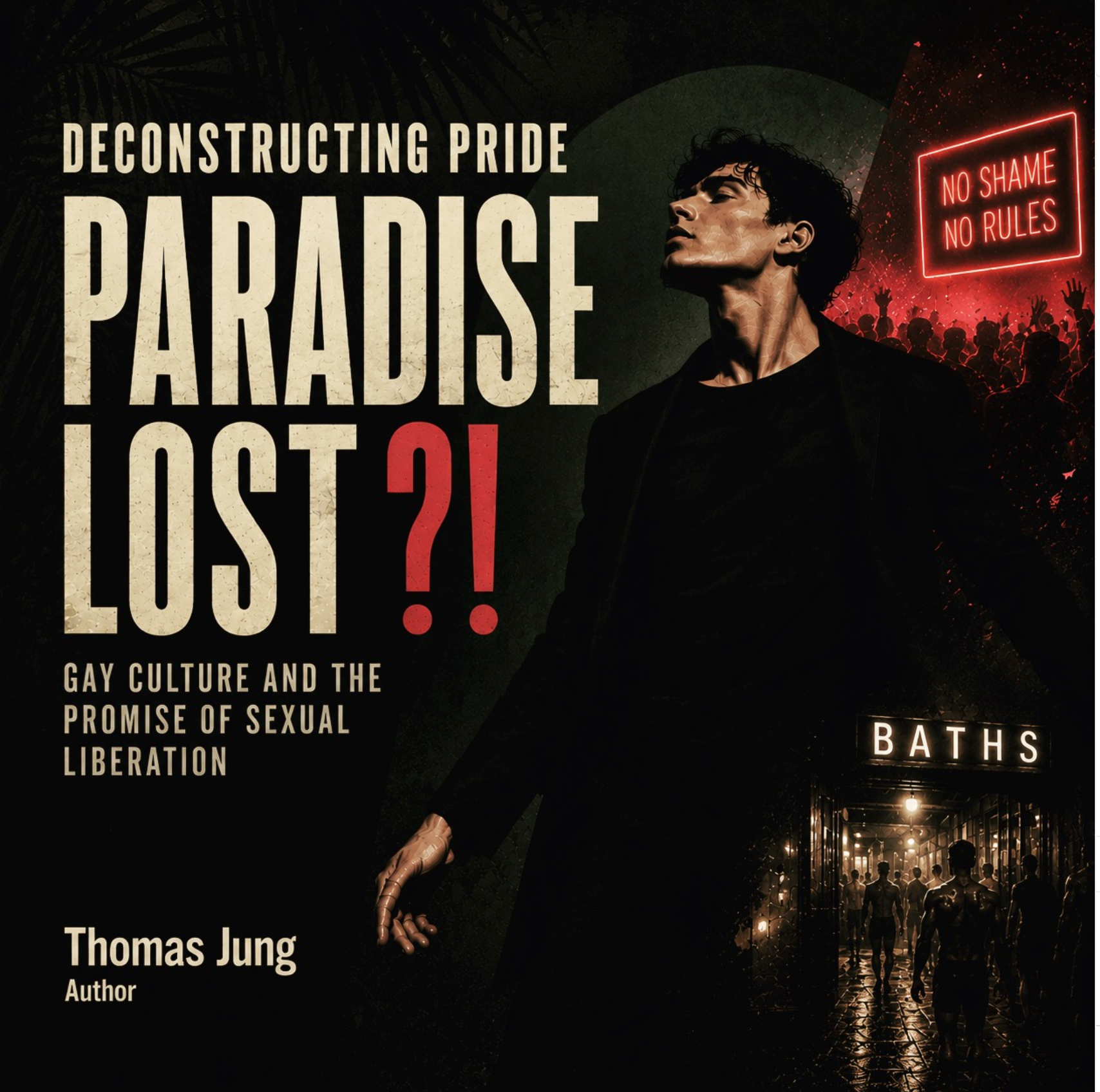
INTRO: AT THE TAIL END OF AN ERA
I was nineteen when I moved to a larger city with a serious nightlife. By then, the great stories already belonged to the past. Men spoke about the eighties and nineties as if they had lived through a vanished world of abundance. I had arrived too late for the legend, though not too late to feel what had made it powerful.
The city still lived off the old infrastructure it had inherited: a wide variety of bars, clubs, and bathhouses, along with backrooms, basements, cruising areas, places upstairs, places downstairs. It had style — dark, slightly hipster, sometimes elegant, sometimes rough. Sex was always at hand. One could find it during the week, at night, during the day, almost at any hour.
I did not need any time to adjust. I felt like a fish in water. The logic was immediately clear. I sometimes went out with friends, though mostly I went alone. I was adventurous. I wanted lots of sexual encounters. If I did not manage to go home with someone from a bar or club, I went to the bathhouse afterwards. The night always offered a second chance, and a third.
The atmosphere fit me like a glove. I belonged there, though not in the way people now talk about belonging. It was not primarily belonging with people. I did not go there to find community in any sentimental sense. I belonged to the world itself, the atmosphere and the movement. Promiscuity, in that world, did not feel sordid or desperate. Often it felt safe, direct, and strangely uncomplicated. That world promised something, and it always delivered.
It gave me a life next to my life. It offered relief from the existence I otherwise had to endure. I felt miserable most of the time. My life was a mess. I was mostly alone. In that world, none of that had to be solved. I felt desired and admired. I could exhibit myself. I could be seen.
In the world in which I came of age, nightlife and online contact existed alongside each other. This was before dating apps. I sometimes met people online, at first through internet cafés. I found sexual contacts that way, though more importantly, I met the people who became my circle of friends. Neither had yet displaced the other.
Even then, I often thought: I was born too late. One could tell. The city still carried the remains of an older nightlife, built for a different rhythm. Some of it was still alive. Some of it had already begun to fall silent. I had arrived after its peak, in time to experience only its decline. An old world was slowly disappearing. When the major bathhouse closed, that was the end for me.
Over the years, the culture I grew up in has shifted. In many ways it has improved. New venues have emerged where partying and sexuality feel more integrated. They attract a younger and more mixed crowd. Yet I have also noticed something else. Many people who appear open-minded and curious on the surface merely perform that attitude. Their reflexes are often judgmental, narrow, and ungenerous.
I am not sure it was always like that. There seems to have been a period in which more was possible. The culture had become more open, permissive, and confident, though it had not yet turned all of that into performance. There seems to have been something more real in it. At least that is how it felt to me. Something was available then that later became harder to find.
A homosexual is often assumed to be sexually liberated. Sexual liberation is treated not merely as part of the lifestyle, but as a vital part of the identity. Very often, he is not. He may want to be, or feel that he has to be, though something in him cannot follow. The attitude is there before the ease is. What is missing has to be performed — or chemically induced.
The performance often appears under the name of visibility. A body is shown, a pose is struck, a sexual attitude is displayed, and all of it is treated as confidence, liberation, even courage. Beneath that display lies a world of comparison, ranking, envy, gossip and exclusion. The public image says freedom. The behaviour often says control.
Whenever this comes to the surface, the explanation is redirected outward. As with so many things in the “gay community,” society is made responsible for what people cannot bear to see in themselves. It is society, apparently, that turns them into small sexual bigots — and society again that has to carry the blame for conduct they refuse to own.
In recent years, there has been discussion of a phenomenon that occasionally surfaces at Pride celebrations and similar events: people engaging in sexual acts on the open street in broad daylight. I have witnessed it several times, though such incidents are rare. I found it disturbing. What unsettled me more was the reaction of some friends. They did not merely shrug it off. Some defended it outright. A few seemed to approve of it.
Asking them why never produced a clear answer. The contradiction stayed with me for years. Gradually, I began to see a pattern. The people who defend these gestures of liberation are often the same people who most need the “look at me, I’m liberated” persona, while seeming to find very little actual joy in sex.
Sexual liberation brought homosexuality into the open, yet the way it unfolded produced something more ambiguous than its advocates had promised. The promise was less fear, less repression, less violence, more honesty, and above all more pleasure. Openness hardened into exhibitionism. Permission became expectation.
Sex, once imagined as a medium of individuality, became another script to follow. A new sexual hierarchy took shape, sharpened by pornography, hookup apps, and social media. What was supposed to produce ease instead generated comparison, performance, and subtler forms of control.
The question, then, is not whether homosexuality became more visible. It did. The question is whether gay sexuality and the culture around it became more honest, more generous, more relaxed — or whether old restraints were simply replaced by new ones. Why does sex appear to be everywhere while the ability to enjoy it, trust it, and live it with ease seems to be slipping away?
THE FUN OF HOMOSEXUALITY
At its best, Looking — HBO’s 2014 series about a small circle of gay men in San Francisco — portrays gay life as something almost self-evident: nightlife, friendship, sex, and ordinary life existing side by side without needing to be explained or justified. Gay life appears as a lived environment, with its own rhythm and texture.
Queer as Folk — Russell T Davies’s 1999 Channel 4 series set around Manchester’s gay scene — offered an account of an older world in a different country. It also presented gay life as an ordinary, lived world and captured nightlife as an engine: going out, meeting someone, going home, and doing it again. Week after week. Gay life appeared directly, as something self-evident, before it had to be explained through an entire identity vocabulary.
TV shows like that can make this world look almost too coherent, almost too perfect, as if it were one single lifestyle package. My own experience was never like that. I was never really part of any one scene. I moved between different worlds and subcultures. That was simply how it was. I never gave it much thought.
These worlds had not yet been gathered under the language of a single identity. It felt as though they could still be lived without interpretation or explanation—intimacy forming without being turned into labels. Even the things that went on sexually often did not have a language yet. Things happened, but they were not immediately treated as evidence of what it says and what it means. In that sense, the world was adventurous without being highly charged.
Youth occupied a different place in that world. Fewer young people entered it then. Many still had a troubled relationship with their sexual inclination, and many simply stayed away. If you were young, you were lucky. There was less competition, and youth itself carried a certain status. Finding sex was not hard.
Sexual promiscuity served a purpose. One could experiment and expand one’s horizons — in group settings, with substances — and much of it retained something spontaneous: not highly organised, not performative. You met people; things happened. You never quite knew what the night might bring. It wasn’t that nothing could go wrong, but the atmosphere did not feel as though danger were lurking everywhere.
Moreover, it offered an escape from a life that often felt unbearable. Not necessarily because one was closeted or ashamed, but because ordinary life itself could feel impossible to inhabit. In that world, none of that mattered for a few hours. It gave life depth, brought one into contact with people one would not otherwise have met, and offered release from loneliness. Being different was fun.
The disappearance of that world may be why the loss still feels so real. Many men feel they have nowhere left to go. The old infrastructure served not only the confident, attractive, and socially fluent. It also gave shy or awkward men a place where they could just be there. Sexuality became possible in a practical way: as something one could reach. That world is profoundly missed.
The atmosphere had a strange combination of edge and accessibility. You could go far without feeling as if you were walking into danger. It was intense without making one paranoid. The world carried a charge you could enter and leave at any time.
Sexuality offered a space in which exhibitionism could be lived fully and honestly. Being looked at, displaying oneself, provoking desire, watching and being watched — all of that could be erotic in itself. It did not merely surround sexuality. It formed part of its core.
The pleasure lay partly in the display. One could enter a space, expose oneself a little or a great deal, notice who was watching, and respond to the atmosphere. Finding one’s way around was part of the adventure. The display had a purpose. It belonged to the encounter. One was not exhibiting a lifestyle, an identity, or a moral attitude. One was exhibiting oneself to other people who had entered the same world.
Over time, exhibitionism stopped being a particular erotic pleasure and became a more general cultural attitude. The body, the relationship, the lifestyle, the trauma, the politics, the meals, the holidays — everything had to be made visible. Sex was pulled into a wider culture of exposure.
Such exposure can make people visible and desirable, yet also make them increasingly difficult to reach. It can arouse desire in others while weakening their ability to enjoy being desired.
This generalized form of exhibitionism rests on a misunderstanding of sexuality. Secrecy, awkwardness, restraint, and privacy are treated as obstacles to be overcome. Yet they are also part of what gives sexuality its charge. Liberation is proved by showing that none of them has any hold over one. Remove them, and the display remains while the erotic element weakens. It produces the very thing it wanted to fight: distance, inhibition, and the loss of erotic ease. Intensity then has to be produced elsewhere.
Erotic exhibitionism worked because it belonged to contained spaces. The transgression had a place. These were rooms people had chosen to enter, where the rules were understood without needing to be explained. That containment made it possible to go further than one would in an ordinary setting. For a few hours, one could become someone else: desired instead of ignored, surrounded instead of lonely, bold instead of inhibited.
Beyond that, the gay world offered a way out of the ordinary script: girlfriend, marriage, children, domestic respectability. Not as an excuse. I did not feel attracted to women at all; in fact, I resented them. Homosexuality felt natural and inevitable. The gay world gave legitimacy to an alternative way of living, precisely because I felt at home in it.
Homosexuality, as lived practice, has always meant more to me than an orientation. It exists inside the social order, but it also pushes back against it: conventional dignity, productivity, order, and family life. The nightlife world made that resistance concrete. It offered a place where the day’s discipline could briefly fall away, where desire and pleasure could shape the experience for a few hours. For people like me, that was not only sex. It was relief from a moral order that felt unbearable.
THE RISE OF HOOKUP CULTURE
At that time, the outlines of what would become hookup culture were already forming. Dating and chat websites were becoming increasingly popular, and a growing amount of arranging already took place online, even before exchanging pictures became normal.
At first, this was not only about finding sex. I met friends through those portals. One could talk, meet, build a circle, and sometimes find sexual contacts along the way. Online contact still belonged to a larger world. It led outward.
The shift was already visible. There was less chance, less movement through the city, more messaging, more selection, more planning: an early version of shopping for sex. What had once happened across bars, clubs, streets, and bathhouses began to move onto a screen. The city stopped being the map. The computer, and later the phone, became the map.
With that came a different mood. One compared more, hesitated longer, kept alternatives open. Everyone became replaceable. Sexual desire became something one could constantly optimize. The encounter mattered less than the possibility that someone better might still appear.
Geolocation intensified the change. Dating became something one could do from the couch. For online dates, people used to travel; at least I did. One went somewhere, sometimes further away, took risks, made an effort. Now more people stayed home, scrolling, waiting, filtering, selecting.
Looking for hookups became an activity in itself, sometimes almost replacing sex. The search became the thing: endless browsing, chatting, selecting, imagining who might be nearby. One could spend an entire evening looking without meeting anyone. The screen promised abundance while producing delay, avoidance, and endless comparison. The culture shifted from doing to scanning.
The old infrastructure began to weaken. Bars, dark rooms, and bathhouses mattered less once the phone appeared to offer direct access. Yet that access was only apparent. The more people remained at home looking, the less reason there seemed to be to go anywhere. The places weakened because the screen promised to replace them, and the screen became more powerful because the places weakened.
At the same time, drugs became more central. GHB, amphetamine, and later methamphetamine entered the scene and slowly became normalised. More people around me began using those substances, and in larger quantities. Sex remained, though it became more tightly tied to chemical intensity, endurance, and extremes.
One thing the older dark-room culture could do was cut through established sexual hierarchies. It mixed people. It reduced preselection. Desire remained partly accidental. One did not always know who would appear, what would happen, or what one might want once it did.
Hookup culture moved in the opposite direction. The grid placed everyone beside everyone else. Bodies, ages, roles, and preferences became immediately visible and immediately comparable. Difference hardened into a ranking system.
Some men became highly visible and highly desired. Others became almost invisible. Everyone learned where he appeared to stand. Attention became a form of currency. Rejection no longer felt like one person saying no. It began to feel like evidence of one’s position in the hierarchy.
This system of comparison changed the character of desire. One no longer merely encountered another person. One measured him against the field. Spontaneity and open-mindedness withered because every possibility arrived already surrounded by alternatives.
Pornography intensified this process. As it became cheaper and more widely available, it did not merely show sex; it supplied the standard. It offered the bodies, the roles, the acts, the faces, the level of intensity, even the coldness. The apps supplied the market. Pornography supplied the product ideal.
People began to imitate its aesthetics and expect its logic. Sex became something one delivered, something one performed, something one had to be good at. Because online content offered an endless stream of apparent availability, people also began to expect that availability from each other.
One no longer simply wanted sex. One wanted only the porn version of it — and, even more importantly, entirely on one’s own terms.
Once sex had to conform to a pre-existing image, control entered the encounter. The other person was no longer approached as someone whose presence might alter the situation. He became material that had to fit a script. Others became merchandise: something to browse, select, use, and discard. Sex took on a consumer logic it has never quite lost.
Manipulation therefore became essential. Hookup culture became not only about pleasure, but about directing the other person into what one wanted. In that atmosphere, people no longer simply met. They sized each other up and compared what was available to them with what seemed available to others.
That comparison produced envy, distrust, and a peculiar bitterness: the feeling that other people had access to a sexual world from which one was excluded. The real thing always seemed to be happening elsewhere — among better bodies, more desirable men, and people who knew how to play the game.
That feeling kept the system alive. The search became compulsive precisely because it rarely delivered what it promised.
Intimacy suffered first. The old rhythm — going out, meeting someone, going home, seeing what happened — was replaced by interruption. One chatted, stalled, compared, disappeared, returned, kept other options open. Even when sex happened, it often felt less relaxed, less warm, less human.
The interface made cruelty cheap. People said and did things on the apps that they would rarely attempt face to face. They ghosted, blocked, and dismissed others without a second thought. The screen removed the immediate social cost.
These platforms attract people with strong narcissistic or psychopathic tendencies, though they also cultivate those traits in others. They offer ideal tools for bullying, stalking, and intimidation. It becomes easy to provoke someone, string him along, belittle him, or make him feel small, and then disappear. In that sense, hookup culture is not only shallow. It can become extremely vicious and dangerous.
Once that atmosphere takes hold, it does not remain on the apps. It spills back into everyday life. People begin to anticipate cruelty, so they pre-empt it. They become colder, more guarded, more strategic.
They learn to speak like marketers and behave like judges.
THE LIBERATED POSE
Sexual liberation did not simply expand what people were allowed to do. It introduced a subtler demand: the need to appear sexually free. One is not only supposed to want it. One is supposed to look like someone who wants it in the right way: unbothered, open-minded, available, never awkward. And if one does not fit that image, one is treated as boring and repressed.
Many people genuinely like this ideal or at least believe they should. The sexually liberated person is imagined as curious about everything, uncomfortable with nothing, always ready to go further. It sounds attractive. It sounds like freedom. Yet in practice, one often notices that the need is not there. People adopt the attitude before they have the desire. They often strive for openness as a self-image, not as an actual appetite.
A friend once said to me: “I envy you, because you can enjoy sex more than I can.” It sounded like a compliment, but it did not feel like one. It felt backhanded, almost accusatory. When I asked him why he thought that was, he said it was because I had entered sexuality much younger than he had. Something in that answer revealed the atmosphere around sex: comparison, resentment, the suspicion that someone else has better access to something you lack.
That is not quite how the gay world presents itself, though. It presents itself as the place where shame, insecurity, and repression can be left behind. Everyone is invited to become what they now call “sex-positive”: open, playful, curious, unbothered. Yet the invitation easily becomes an obligation: one is expected to have overcome these things, or at least to perform as if one has. The culture pretends to have defeated shame and resentment, but often merely gives them a more liberated costume.
People often speak as if they are endlessly open-minded. In real situations, however, one often sees hesitation, awkwardness, sudden boundaries, even quiet panic. Instead of acknowledging the gap, they redirect it outward. They turn their unease into judgment, gossip, and quiet forms of punishment. Some seem determined to ruin for others what they cannot enjoy themselves. The appearance of liberation becomes a disguise for insecurities they refuse to recognize in themselves.
At the heart of this lies a contradiction: many people want a great deal of sex, think about it constantly, organize their lives around it, and display that appetite as part of who they are, yet they do not seem able to enjoy it with much ease. Often, they seem to have lost that ease altogether. The pleasure is not there. What cannot be lived convincingly is therefore shown.
That may also explain why some defend public sexual acts, or other exaggerated gestures of liberation, so fiercely. Display becomes a substitute for enjoyment. And when that contradiction comes to the surface, society is blamed for it.
Central to the culture of the liberated pose is the obligatory character kink has taken on. Not necessarily because so many people truly have it, but because kink signals something: that one is not boring, not timid, not afraid. It becomes evidence of belonging. Even when someone is not actually drawn to it, he is expected to be open to it, at least in theory. Once that becomes the norm, sexual liberation stops feeling like freedom. It starts to feel like an exam one is expected to pass.
One of the most accessible ways of signalling kink is to wear sportswear during sex. At certain parties, men wear football shorts, jockstraps, trainers, socks, singlets, and tracksuits. Sportswear is a thing. I understood that. Yet it did not come naturally to me. It was presented as kink, though to me it often felt more like a dress code: a look, a signal, a way of belonging to the atmosphere.
Once, a friend and I visited a couple who sent us to a bedroom with a large closet full of sportswear and told us to choose an outfit. It was playful, even generous, but it also revealed something: we had to dress ourselves into the mood. One could wear the costume of sexual openness without necessarily feeling the desire it was meant to express.
I have often wondered why I do not really have kinks myself. Perhaps my homosexuality already felt deviant enough. It carried its own edge. As homosexuality became more ordinary in mainstream culture, kink began to supply what had been lost: the sense of crossing a boundary. At Pride, that need becomes visible in the harnesses, dog masks, fetish gear, and near-nudity that increasingly function as a uniform.
And whenever the “demonstrators” are asked why they dress so minimally, or why they wear such standardized attire, one rarely gets an answer that makes much sense — if one gets one at all. People seem to feel that this is what one does. And when enough people do it, the feeling begins to look like a truth.
This is exhibitionism collectivized. What begins as a private pleasure in being seen, or an erotic game inside a chosen space, becomes a group ritual. The crowd gives the display authority. What might look strange or empty on one person begins to appear meaningful when enough people repeat it together. The display becomes a signal of status and belonging: the right attitude, the right posture, the right cues.
Because it is a signal, it also becomes coercive. Participation is encouraged; approval is expected. What presents itself as sexual freedom begins to impose a new standard, and those who resist it are treated as prudish, judgmental, or dangerous. That is where the ideals of sexual liberation turn into conformity.
The in-your-face character is not incidental; it is the point. The display is brought into the street, into daylight, before people who never asked to see it. Yet it no longer challenges the dominant ideas of the age. It performs them. Homosexuality has become one of the emblems of liberal society, and the display deliberately pushes that emblem into absurdity.
Once it becomes highly ritualized, pleasure gives way to a politics of visibility and position: who may display, who is expected to approve, and who is placed outside the circle. Who can still enjoy sex in such an environment?
I have spent enough time in venues and at parties where nightlife and sexuality merge. I never felt any need to document them, photograph them, speak about them endlessly, or drag them into the street. Their appeal lay partly in remaining hidden. Why expose it to daylight? Why turn it towards an audience that never asked to see it?
Many people who attend these marches imagine themselves as rebels. In many ways, they are the new petty conformists: the respectable crowd of the age, dressed as transgressors.
THE POLITICS OF DISPLAY
All the rhetoric around public exhibitionism suggests equal freedom. In practice, it remains largely a privilege of the confident, the desirable, and the socially protected — those who can display themselves without consequence. For everyone else, it becomes another standard against which they are measured: are you open-minded, are you liberated, do you belong to the right crowd, can you keep up? The more such display is normalised, the more sexuality becomes a hierarchy of status.
Exhibitionism also has a verbal form: the need to talk about sex, or to make sure others know one is having it. In my experience, those who speak about it most endlessly are often the least convincing when sex actually occurs. They narrate, boast, and construct an image, yet when the moment arrives, there is often very little there. That, too, is the logic of an exhibitionist culture: more noise, less sex; more attitude, less erotic ease; more discourse, less encounter.
Over the past twenty years, the old overlap between nightlife and sexuality has narrowed. Mainstream venues have become tidier, more mixed, more presentable, and less sexually charged, while explicitly sexual nightlife has retreated into specific clubs, backrooms, and more specialised scenes. Sex has not disappeared, but it has become more compartmentalised: something one either seeks out in designated spaces or replaces with talk, scrolling, and pornography.
The paradox is difficult to miss. Public display has grown louder and more theatrical, while gay nightlife has become cleaner, more presentable, and less sexually charged. Sexual expression has moved onto screens, yet Pride has become increasingly sexualised. Ask why, and the answer is often immediate: homophobia. Things are getting worse again, one is told.
The development itself is rarely examined; criticism is simply treated as evidence of the prejudice it is supposed to expose. What appears there is often not the expression of an actual sexual life, but the performance of a cultural ideal: openness, liberation, group belonging. It mimics sexuality while functioning mainly as symbolic costume.
Read favourably, Pride parades can be seen as an expression of a wider contradiction. A materially exhibitionistic culture — exhibitionistic not only in what it owns and displays, but also in its morality — produces people who are preoccupied with sex, yet increasingly unable to enjoy it.
Gender-non-conforming participants may understand Pride primarily as a challenge to those conditions and the norms that sustain them. Many gay men, however, seem to invest it with a different meaning: sexual indulgence, status, and belonging.
Once sexuality is reduced to an almost uniform dress code, it can be worn by people who are not actually comfortable with sex at all — people still driven by fear, status pressure, insecurity, and the need to be seen on the right side. Public permissiveness then becomes a substitute for a private reality that is often much more cautious, much more limited, and much more anxious than the display suggests. The sexualised dress of Pride gives that contradiction a visible form.
At times, these displays resemble the mass parades of communist and fascist regimes. The only difference is aesthetic: they appear in a vulgar, cartoonish, and messy form. What presents itself as individual freedom becomes a collective ritual in which the correct attitude has to be made visible. The supposedly liberal order begins to acquire an authoritarian character: one may dress as a transgressor, but one is still expected to march in formation.
Perhaps that also helps explain why these events keep growing — in number, scale, duration, and geographic reach. A ritual of this kind cannot remain modest. It has to repeat itself, occupy more space, attract larger crowds, spread to more cities, and extend from a day into a week, then a month. Expansion becomes proof of legitimacy. The larger the display, the harder it becomes to question what it represents. What looks like spontaneous celebration increasingly resembles the ceremonial self-affirmation of an order that needs to see itself everywhere.
That is the point: sex has been reduced to the aesthetic of an authoritarian order — to display and discourse rather than lived experience.
The need for an audience follows from this. Once sexuality becomes a proclamation, it is no longer enough simply to live it. It has to be seen, recognized, and affirmed. That is why the display moves into daylight, onto the street, and before people who never chose to enter it.
From there, a new hierarchy emerges. Those who display most convincingly, or push furthest, begin to define what liberation looks like. Everyone else is measured against that standard: approve, participate, or be placed outside the circle.
Why does this way of thinking resonate so strongly? Because it offers a flattering explanation for sexual unease. Inhibition is no longer treated as something personal, but as something imposed by society: by shame, upbringing, and the demand that sexuality remain private. Public display then presents itself as opposition to that order.
The great deception lies in presenting it as opposition. They continue to inhabit a society of the past, fighting a morality that no longer governs the culture. What they call rebellion is largely conformity to the morality of the present: openness, disclosure, visibility, and the public performance of one’s truth.
Underneath it lies the assumption that sex is the privileged language of authenticity. The more openly one displays it, the more liberated and honest one appears. The gesture still borrows the language of rebellion, but its enemy is a ghost from a bygone era.
The same impulse appears elsewhere. I have met people who enjoy outdoor cruising and also defend open drug use. The logic is similar: take what is meant to remain hidden and force it into view, as though visibility could turn it into freedom. What is private or shameful is expected to become harmless once exposed, perhaps even virtuous.
Gay culture then presents itself as a challenge to social hypocrisy: look how much you hide, look what you call normal. Yet the claim is not convincing. There is nothing inherently hypocritical about wanting sexuality to remain private, secluded, or discreet. Those may simply be the conditions under which intimacy remains free, playful, and enjoyable.
A quieter version of the same logic appears in the symbolic use of places and cities. Sexual freedom is signalled not only through what one does in public, but through where one goes, what one photographs, and which worlds one claims access to.
NETWORKS OF CONTROL
It becomes visible in a phenomenon I would call “Going to Berlin.” I have met many people who talk about going there, or signal it in their online profiles, often through photos. For quite some time, it was fashionable to pose at the Holocaust memorial, sometimes even in mildly fetish-themed outfits.
The city is one of the few places with a real infrastructure left. Not only bars or clubs, but a whole ecology: nightlife, fetish events, sex-positive spaces, anonymity, people arriving from elsewhere, and the sense that one could still enter a world instead of merely scrolling through one. That was its attraction. Berlin still feels like a place where something can happen.
The city has become a badge of something and therefore carries a certain prestige. For some, it reflects something real. You can tell because they do not need to emphasize it. For many others, it is mostly noise and show: a way of signalling that they belong to a world supposedly freer and wilder than the one they have to live in, even within the gay world.
What does Berlin tell us? It tells us: I cannot do at home what I do here. Partly because of the culture — the distrust, the talk, the gossip, even among people who claim to be open-minded and liberated. At the same time, it also tells us something about the people themselves. They flee to Berlin from the very behaviours they are themselves engaged in at home: the judging, the policing, the anxiety, and the need to be seen as liberated. They escape a culture they are helping to reproduce.
Berlin has become a curious mixture: a pilgrimage site for homosexuals — almost like a secular Lourdes — a place where people go for sexual “healing,” and at the same time a refuge from the narrow-minded culture in which they live. But what strikes me is that it rarely seems to occur to them that the problem is not only “out there,” in the town they live in. Part of it is their own attitude. They go to Berlin to feel free, or at least to appear free, and then they return home unchanged.
In that sense, the city becomes a measure of how little is happening elsewhere. Yet part of what makes home feel so empty is the culture people reproduce there themselves. In smaller towns and suburban settings, homosexuals often meet one another with suspicion. There is gossip, avoidance, and constant attention to who knows whom.
The apps intensify this atmosphere. Profile pictures are often outdated, if they appear at all. Anonymity is low, social circles overlap, mutual acquaintances are everywhere, and the fear of being talked about never quite disappears. At times, the whole scene can feel like a snake pit: eat or be eaten.
Out of this grows a culture of power and control. People manage one another through information. Even when little happens, they still want to know what might happen, and who might do what with whom.
That is the contradiction. A promiscuous culture depends on discretion, yet gossip destroys the very conditions that make promiscuity possible. One requires openness; the other poisons it. I have always been struck by how many gay men seem committed to both, as though one did not steadily undo the other.
I once experienced this in a way that stayed with me. Someone I had known since childhood invited me over; I had not seen him for more than fifteen years. Soon after I arrived, he mentioned that he had also invited another person we had both known growing up, adding: “He has a big dick.” At that moment, I understood where the evening was heading. It had not even occurred to me. I had come simply to see an old friend.
The other man seemed pleasant enough, but I could not imagine either of them as a sexual partner. After some conversation, with nothing having happened, one of them took out his phone and opened Grindr. They moved through the grid picture by picture, telling me who the men were and whether they were good, bad, or even dangerous. I was taken aback. I was not inexperienced, yet I had never encountered that kind of behaviour before.
What disturbed me was not only the shamelessness of the talk, but the bookkeeping mentality behind it. I had always assumed that promiscuity required a certain discretion: one did not speak about sex and other people in that way. Yet here, sex was not only something people did. It was something they recorded, assessed, and circulated.
Had I given in to their advances, they would almost certainly have told others. The encounter would not have remained between us. It would have become material: something to repeat in another room, to another person. That is what people like this often seek. They do not come only for sex. They come for information.
Much later, I met someone who kept an entire archive of men on his phone, including nude photographs. I had explicitly asked him beforehand not to talk about other people. He ignored the request and showed me the images anyway, as though they were proof of status: whom he knew, what had been sent to him, whom he might have had access to. I found it deeply disturbing.
I also had the impression that he had not come entirely on his own initiative, but as part of a wider group or network. Whether that impression was correct hardly mattered. The effect was the same: the encounter no longer felt private. In recent years, I have come to realize that one is never in bed with only one other person. There are always others present at a distance.
These incidents reveal something about the culture. Even when people do not, or cannot, gain access to the men they want, they still want to know who does what with whom. If they cannot participate, they can still observe. Sexuality becomes something to follow, record, and manage from the side. That is not liberation. It is control. Away from the large urban centres, sexuality often becomes less something people live than something they monitor.
In regimes of control, power often works through small local overseers: the block warden, the person who knows who visits whom, who belongs where, who can be trusted, who should be watched. A similar figure exists in parts of gay sexual life: the man who feels in charge of a little sex network.
He knows the names, the preferences, the weaknesses, the rumours. He controls access, makes introductions, spreads warnings, creates dependencies. Very often substances are involved. Drugs do not only intensify sex; they also bind people to the network. These power dynamics then work their way into friendships, hookups, and relationships.
There is a darker side to this. Once people begin to see themselves as gatekeepers of such a network, the same mechanisms can turn into bullying, stalking, intimidation, and coordinated harassment. Information becomes a weapon. Someone can be excluded, warned against, mocked, followed online, provoked, or made to feel watched.
No formal organisation is required. A few people talking, hinting, repeating, and acting in concert may be enough. What appears to be a loose sexual scene can begin to resemble a regime of social control.
Another development I witnessed was the rise of certain obsessions within that world. They presented themselves as harmless preferences, healthy fashions, or simply evidence of an open mind. One response became almost a refrain.
On the apps, when I said I was not interested, the answer was often not “fair enough,” but: “Yeah, but he has a big dick.” As though that single detail should override everything else, settle the matter, and make refusal seem unreasonable.
For years, I wondered what lay behind this. Before online dating displaced older ways of meeting, sex was approached differently. In a bar or club, one met someone, followed the situation, and saw what happened. Sometimes it was good; sometimes it was not quite what one had expected or wanted. That uncertainty was part of the experience. Sex offered a wider range of encounters because it had not yet been reduced to a single preselected trait.
All this feels so primitive. Part of it is that a single measurable feature has become a kind of sexual currency. It functions like a shortcut: it promises intensity and a guaranteed outcome, as compensation for a lack of connection. At the same time, it turns sex into a form of comparison and competition — sculpting the new sexual hierarchy.
Strangely, the people most disadvantaged by this hierarchy often enforce it with the greatest loyalty. They seem to believe that submission to its rules will eventually give them access to the sexuality others are supposedly enjoying. Behind it lies the fear that the real thing is happening elsewhere: among better bodies and people who know how to play the game. One often hears the familiar claim: “I came from a small town, and I was the only gay person there.” I have always found that explanation too simple. Smaller places can be limiting, and there may genuinely be little happening. Yet people rarely ask whether they themselves also help create that emptiness.
Sexuality is not only something one finds. It is also something one permits, attracts, or quietly prevents. One has some influence over these things, even when one is not fully aware of it. When I was young, I never experienced the world as entirely closed. There were always possibilities, if one remained open enough to notice them.
Part of the problem is the belief that the apps are where everything happens. The screen presents itself as the centre of sexual life, and ordinary life begins to look empty by comparison. I am no longer convinced that this is true. People still encounter one another — not instantly, not on command, and not according to a list of specifications. The demand for immediate access is often an illusion produced by the medium itself. Sometimes one has to wait. All good things come to those who wait.
These anecdotes point less to sexual activity than to the conditions that make it possible: trust, discretion, and warmth. Once sexuality becomes something to track — who is good, who is bad, who is off-limits, who does what with whom — sex stops happening between people and becomes something managed from the outside. One can be surrounded by men and still feel that nothing can begin, because everyone is half in the room and half in the grid.
That is also why so much of the culture feels so hostile. The ideal of promiscuity remains important to many gay people, but it often has very little to do with sexual liberty. Sexual desire is constantly watched, assessed, and turned into information. Promiscuity, instead of opening things up, becomes part of a system of control.
In such an atmosphere, intimacy becomes risky and confusing: you are not just meeting a person; you are entering a network and a power structure. Once ordinary contact becomes that difficult, it becomes easier to look for shortcuts — either to force intensity back into the situation, or to retreat into a different form of control.
MANUFACTURED INTENSITY
One response to this loss of sexual ease has been the growing sexualisation of drug use in group settings — often referred to as “party ’n play” or by some other clumsy expression. Many factors have contributed to it, but its spread also belongs to the developments described here: as sex becomes less available, more monitored, and more shaped by pornographic templates, intensity has to be produced artificially rather than found.
The phenomenon brings together three things that have long held a certain fascination in gay culture: drugs, promiscuous sex, and connection without much effort. In that sense, it offers an escape from dating, which many men experience as tiresome, unstable, and endlessly confusing. It promises access to sexuality and brotherhood without the uncertainty and constraints of romantic involvement.
The culture rests partly on the assumption that sexuality remains suppressed or undervalued. Sex therefore becomes something one is expected to want, affirm, and satisfy constantly. Yet the sexuality that emerges is increasingly detached from bodily urgency. It becomes cerebral, aestheticised, and controlled: something planned, curated, and staged rather than something that simply overcomes one.
Substance-induced group sex offers a contained stage for exhibitionism, yet even here inhibition does not disappear. In many settings, little sex takes place. People gather, use substances, and mostly talk. Some come for sex; others remain inhibited or disengaged. The drugs do not necessarily bring them together. Moods and mental states fragment, making intimacy difficult and often unsatisfying.
Substances may reduce inhibition and generate arousal, but they cannot create connection. Without it, the intensity does not hold. Over time, people may lose the ability to have sex without chemical assistance and come to believe that nothing else could ever match it.
Sexualised drug use is not new. I remember a time when it was more spontaneous: people met, drugs appeared, sex might happen, or not. What distinguishes the current form is not so much the substances themselves as the degree of organisation. It has become a scene with rules, expectations, hierarchies, and informal gatekeeping.
The same dynamics reappear here. People talk. People warn. People keep track. Wrapped in secrecy, the atmosphere can quickly turn vicious, organised around control and status — now intensified by substances.
These gatherings carry more than the obvious dangers of the drugs themselves. They also attract people who know how to exploit confusion, dependency, and lowered boundaries. I have seen such settings bring out something genuinely malicious. The atmosphere can turn dangerous quickly. There have been reports of rape and other abuses, as well as stalking and coordinated harassment. When people are on drugs, boundaries blur, perception blurs, memory blurs.
Add gossip, social overlap, and the fear of being talked about, and the whole setting becomes even harder to read. Serious violations can occur in the middle of what feels like heaven and then disappear into the fog. It becomes difficult to understand what is happening in the moment, and even harder to establish afterwards, because everything can be questioned — including by oneself.
In recent years, I have begun to reject these gatherings altogether. Not only because of the obvious risks, but because they increasingly resemble network events. People move from Pride to Pride across Europe, posting the journey online. The parade is often not the real attraction. What matters is the small circuit that gathers around it at night. Is that what being gay has become? I do not like where it is going.
Alongside the sexual network stands an entire supporting world of pharmaceutical normalization: PrEP, testing, clinics, prevention language, NGOs, apps, and “sex-positive” branding. None of these things is objectionable in itself. PrEP offers protection; testing and harm reduction matter. Taken together, however, they can lend a risky culture the appearance of being modern, responsible, even progressive. What is managed begins to look harmless.
Friends of mine often describe attendance at such parties as a political act. I understand what they mean. When I was younger, participation in that world could feel like resistance: to respectability, normality, and the demand to behave. It carried that charge.
Yet when the same gesture is repeated year after year, party after party, it begins to lose its force. At some point, it becomes like a punk still walking around as though he were twenty: no longer rebellion, but attachment to the image of rebellion. One keeps holding on to something that no longer fits. The people who remain in that world often have motives other than sexual freedom.
There is also something unconvincing about the idea of activism through promiscuity. Those who most insist that attending these parties is political often live otherwise entirely comfortable lives. Some are proud of owning expensive apartments in desirable cities, moving easily through property, careers, travel, and status, and then present attendance at a drug-fuelled sex party as their form of resistance. I find that hard to take seriously.
I have known people who did little else but organise such parties, moving from place to place and living almost nomadically, often in poverty, around that world. It may not have been respectable, but it was more credible. There was at least no great distance between the claim and the life. Those were the people I liked and trusted most.
TWO WAYS OUT
Sexualised drug taking is perhaps the most extreme response to the limits of ordinary sexuality. It tries to answer lack with excess. Behind the ideal of promiscuity lies a fantasy that is rarely admitted: I want them all. Reality does not allow that. Ordinary sexuality cannot sustain such a desire.
It runs into hesitation, refusal, competition, and the simple fact that desire is not endlessly reciprocated. Free and easy sex is an illusion. It always comes at a price. Substances become a way of forcing the fantasy into reality, or at least pretending for a few hours that it has become possible.
Eventually, the price may become too high. A life built around this kind of intensity can become unsustainable — physically, socially, mentally, financially, even morally. The desire remains, but the body, age, and loneliness impose their own limits. At some point, one has to ask whether the promise still gives enough back for what it demands.
Some respond by escalating: more substances, more extreme settings, more carefully staged intensity. Others turn towards control, becoming harsher, more possessive, and more punitive. Somewhere beneath it lies the knowledge that the life is no longer working. That is precisely why it has to be defended so fiercely.
The failure cannot be allowed to come from the life itself. It has to come from outside: from those who do not understand it, who judge it, or who supposedly stand in its way. The worse the life becomes, the more necessary the enemy becomes. From there, the demand for control spreads outward — over desire, over bodies, over who is allowed to remain and who is pushed out. That dynamic feeds a culture of envy, hostility, and exclusion.
Many homosexuals who adopt the gay identity claim to have found in sexuality an escape from certain group dynamics: the pressure to belong, the social games, the envy, the small humiliations, the constant ranking. Yet the same dynamics are recreated within the gay world, often in more vicious forms. Certain personalities do not fit such a world. They never really did. The question then becomes what remains for them.
One possible response is a trend that appears stronger among heterosexual men, though I have also encountered gay men who subscribe to it: semen retention. The practice centers on deliberately withholding release, avoiding ejaculation and sometimes sexual activity for extended periods of time. It belongs to the wider world of the so-called manosphere, with its language of discipline, self-mastery, and contempt for weakness.
People often imagine gay people as far removed from that world, even as people who need protection from such men. I am not so sure. There is more overlap than either side likes to admit: the same obsession with bodies, status, hierarchy, sexual conquest. Visually, some of these men resemble the stereotypical man one might encounter on a gay cruise. Both worlds are shaped, even formed, by a certain kind of misogyny. When analysing it, however, one should look beyond its most obvious forms.
Semen retention means abstaining not only from sexual acts with others but, more importantly for some, from masturbation. It is not necessarily celibacy; it is not meant to be permanent. The practice should help unleash hidden potentials, achieve personal goals, and foster creativity. It is also meant to restore a “healthy” sexuality, free from pornography. Sexual energy, in this view, needs to be directed and controlled, including toward purposes other than sex.
The practice promises greater attractiveness, spiritual discipline, and a healthier relation to desire. For men who have come to rely on drugs to enliven their sexuality, it may offer a route away from chemical intensity. It may also help loosen the grip of sexual obsessions and patterns that have become difficult to control.
By stepping outside the consumer logic sexuality has taken on, a man may become less susceptible to sexual fashions, imposed preferences, and real or imagined kinks. He may also recover a clearer sense of connection and of what he actually wants from another person.
The power found in saying no to sexuality is also presented as a way of finding a suitable partner. In a promiscuous world, how does one know who the right person is? By stepping back from pornography, release, and constant sexual availability, the practice promises to restore a clearer sense of whom one desires and why.
In that sense, sexual restraint can also be understood as a refusal of what Pride has come to stand for. It is more than simply not attending a parade. It means resisting the demand to affirm sexuality constantly, display openness, treat desire as an obligation, and regard every inhibition as something to overcome. The refusal is directed not only at an event, but at an entire sexual culture and the power structures it serves.
When I was younger, I could live promiscuously with a certain adventurous ease and playfulness. As I grew older, that ease began to disappear. It became less enjoyable, while other things grew more important — for me, and for many others. The lifestyle no longer gave what it once had.
Letting go is difficult, not simply because one lacks self-control, but because that life stood for more than sex. It was bound up with being different, rebellious, and adventurous. Sexual restraint can help one leave behind unhealthy and self-sabotaging patterns that belong to a time when those habits still offered something real.
To me, this is not only a matter of growing up sexually. Society, too, needs to free itself from distorted ideas about sex and sexuality inherited from the so-called sexual revolution of the 1960s — ideas that gay culture has not merely adopted, but continues to push with particular force.
These two “ways out” look like opposites—chemical intensity and ever more extremity on the one hand, disciplined refusal on the other—but they respond to the same situation. Both are reactions to a culture in which sexuality is everywhere as an idea, yet contact is scarce; where sex is treated as a central promise, yet becomes harder to live in simple, human ways.
The irony lies in what sexual liberation produced: it did not only free sex from rules; it also helped detach sex from intimacy, and it left many people searching for intensity or control in order to feel anything at all.
Sexual liberation promised better sex, less violence, and a lighter relation to desire. Yet in the world I have been describing, sex did not simply become freer; it became more organised. What was promised was a world in which sexuality could become lighter, more natural, less burdened — something that could simply happen. Instead, it often became heavier. A culture can become more open in language and more closed in reality.